
Top Eyewear Display Case Manufacturers for Global Buyers

Time:2026-09-28 Author:Ethan
0%

Selecting the right Eyewear Display Case is more than a styling decision. It affects product visibility, frame protection, staff access, and the customer’s first impression. Grand View Research estimated the global eyewear market at USD 183.36 billion in 2023 and forecast continued growth through 2030. The report concerns eyewear, not display fixtures, but its scale helps explain why retailers scrutinize store presentation and merchandising.

Details matter. A buyer comparing global manufacturers should examine glass clarity, hinge durability, lighting color, lock quality, and replacement-part availability. Ask how the case handles fingerprints and daily cleaning. Request material samples and drawings before approving a large order. Small checks can prevent expensive surprises.

Design has a measurable role. Donald Norman, a design researcher and author of Emotional Design, wrote, “Attractive things work better.” His principle applies to eyewear displays: a clean sightline can help frames look inviting, while glare or crowded shelves can obscure their details. Yet attractive is not enough. A beautifully lit case may still be difficult to clean or service. That trade-off deserves attention.

This guide compares leading Eyewear Display Case manufacturers for international buyers. It considers customization, production capability, quality controls, shipping support, and communication—not just catalog images. Supplier claims should be verified with specifications, references, and a sample whenever possible. A polished brochure is only a starting point.
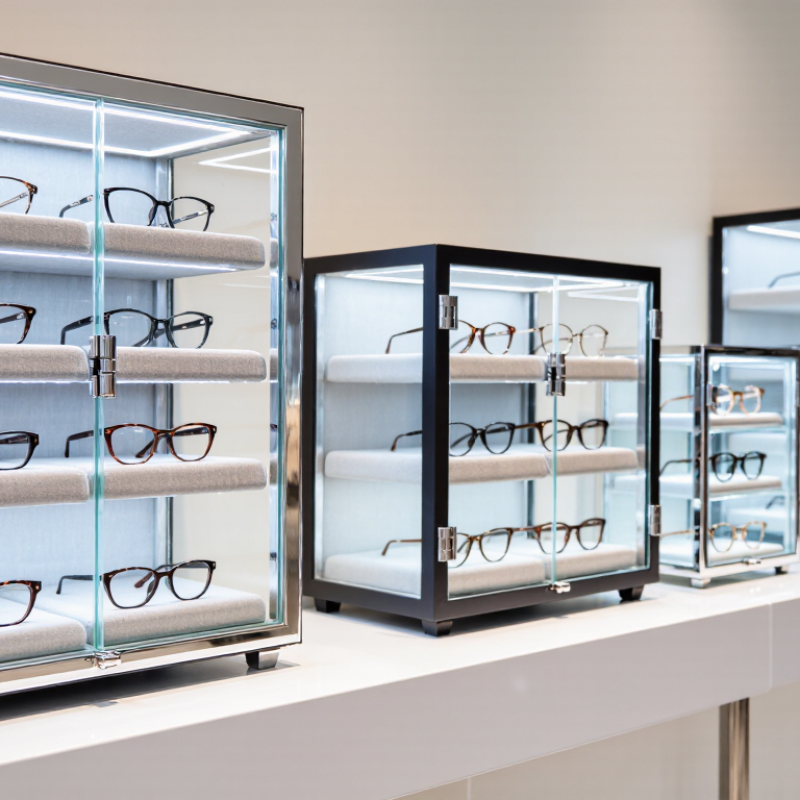
Top Eyewear Display Case Manufacturers for Global Buyers

Eyewear Display Cases: Types, Materials, and Retail Applications

Eyewear display cases do more than store frames. They improve visibility, limit handling, and help shoppers compare shapes and lens colors. Countertop cases suit compact optical shops, while wall-mounted cabinets keep floor areas clear. Freestanding units work well near entrances, where they can feature seasonal collections. Lockable glass cases add security, though they may slow browsing if staff must unlock each selection.

Material choice affects appearance and daily maintenance. Tempered glass offers a clear view and stands up to routine contact. Acrylic is lighter and easier to reposition, but scratches more readily during cleaning. Aluminum frames provide a neat, durable structure; wood can bring warmth to a boutique setting. In busy stores, smooth edges and replaceable shelves matter as much as finish. Dust shows quickly. It is easy to underestimate.

Lighting should reveal frame details without causing glare on lenses. Neutral white LEDs can make colors easier to judge, while adjustable brightness helps with reflective surfaces. Shallow trays organize folded frames, but crowded layouts make comparisons difficult. Measure frame depth and shelf spacing before ordering; oversized sunglasses need more room than slim optical frames. Staff should also be able to clean the interior without removing half the display. Retail needs vary, so test a sample layout with actual products before committing.

How to Evaluate Eyewear Display Case Manufacturers

An eyewear display case should protect frames and make them easy to inspect. Ask manufacturers for a sample built to your actual frame dimensions. Details matter. Check whether nose pads or temples catch on dividers, and whether clear panels create distracting reflections under store lighting. Open and close doors repeatedly; loose hinges may not show in product photos.

Evaluate materials and construction, not just the quoted price. Request specifications for panel thickness, edge finishing, shelf load, and surface coatings. Ask how the factory checks dimensions and appearance before packing. A small sample with uneven seams can reveal more than a polished catalogue image. If the case needs custom colors or inserts, confirm how changes affect tooling, lead time, and replacement parts.

Shipping is part of the product. Ask for packaging photos or a trial shipment, then inspect corners, protective layers, and how panels are secured. Get written confirmation of dimensions, finish, quantity, and delivery schedule. Communication matters, too: clear answers to technical questions are a useful sign, though they cannot guarantee consistent production. I would still inspect a production unit before approving a large order; samples and factory descriptions sometimes leave details unresolved.

Leading Manufacturers and Their Areas of Specialization

Eyewear display case manufacturers often specialize in distinct materials, formats, and retail needs. Some produce modular acrylic units for busy optical stores, where clear sightlines and quick product changes matter. Others focus on wood, glass, and metal cases for boutiques seeking a warmer, more tailored interior. There are also manufacturers equipped for large retail programs, offering repeatable dimensions and coordinated fixtures across multiple locations. Details matter. Hinge movement, shelf spacing, and glare can affect how frames look under store lighting.

Buyers should match a manufacturer’s strengths to the intended setting, then check samples and production details. Ask how shelves are adjusted, how glass edges are finished, and whether replacement parts can be supplied. A maker experienced with compact countertop displays may not be the best choice for a full wall installation. Likewise, elaborate finishes can add visual appeal but may require more care. A polished sample can still hide uneven color between production batches, so request clear specifications and inspect a production unit when possible. This is easy to overlook. Comparing lead times, packaging, and communication helps reveal whether a supplier can support the project beyond the first delivery.

Comparing Customization, Quality, and Global Supply Capabilities

Eyewear display cases must protect frames while making them easy to inspect. Grand View Research estimated the global eyewear market at USD 183.36 billion in 2023, with continued growth projected through 2030. That scale makes dependable display supply important, but market growth alone does not guarantee a good case. Buyers should compare custom dimensions, finishes, tray layouts, and lighting options against their actual store space and product range. Small details matter: a smooth hinge, secure frame slot, and clean acrylic edge can improve daily handling. Samples help. Yet one sample cannot prove every production batch will match.

Quality checks should cover material consistency, assembly, surface scratches, packaging, and transit damage. Ask manufacturers for inspection records and clear tolerances, not just attractive product photos. Global supply capability also means more than shipping abroad. Confirm minimum order quantities, production lead times, export packing, and how repeat orders will match the original finish. A protective corner and tight carton fit can prevent costly damage on long routes. Be candid about trade-offs: extensive customization may raise costs or slow replenishment. A polished sample can still hide problems at scale. That is worth checking before committing to a large order.

Choosing a Manufacturer for Different Markets and Business Needs

Choosing an eyewear display case manufacturer starts with the market, not the catalogue. Grand View Research estimated the global eyewear market at USD 183.36 billion in 2023, with growth projected through 2030. That scale hides very different retail needs. A boutique may need a compact, lockable cabinet with warm lighting. A high-volume chain may prioritize modular shelves, durable hinges, and easy replacement parts. Buyers should ask manufacturers for material samples, lighting specifications, and packaging details before approving a production run.

Market conditions also shape practical choices. Humid locations call for finishes that resist corrosion, while stores with limited floor space benefit from narrow, wall-mounted displays. For export orders, confirm dimensions, installation instructions, and shipping protection with the supplier. Request photos or a prototype showing how frames sit on the shelves; attractive renderings can conceal awkward spacing. A common planning gap is underestimating cleaning and restocking time. That detail is easy to miss.

Tips: Compare total landed cost, not just unit price. Ask for a sample, warranty terms, and lead-time estimates in writing. Check whether replacement components remain available after the initial order.

Top Eyewear Display Case Manufacturers for Global Buyers

Choosing a Manufacturer for Different Markets and Business Needs

Ratings use an illustrative 1–5 planning scale to compare common buyer priorities; they are not survey results or ratings of specific manufacturers. Validate lead times, compliance requirements, customization, and order quantities directly with suppliers.

FAQS

What types of eyewear display cases do manufacturers make?

Some make modular acrylic units for busy stores. Others build wood, glass, and metal cases for warmer interiors. Details matter.

How can I choose a suitable manufacturer?

Match its experience to your store layout and display size. A maker of countertop units may not suit a full wall installation.

Which details should I check in a sample?

Test hinge movement, shelf spacing, frame slots, and edge finishing. Look for scratches or uneven color. Samples help.

Can one sample confirm production quality?

No. A polished sample may differ from later batches. Ask for written specifications, tolerances, and a production-unit inspection when possible.

What quality checks are useful?

Check material consistency, assembly, surface scratches, and packaging. Request inspection records, not just attractive photos.

Which customization options should I discuss?

Confirm dimensions, finishes, tray layouts, and lighting. Compare each option with your store space and frame range.

What should I confirm about global supply?

Ask about minimum order quantities, lead times, export packing, and repeat-order finish matching. Shipping capability alone is not enough.

How can packaging reduce damage during transit?

Protective corners and a snug carton can help guard cases on long routes. Still, packaging deserves a real transit check.

What trade-offs can customization bring?

Extensive changes may raise costs or slow replenishment. I might overlook that when focusing on appearance; check timing before placing a large order.

Conclusion

This guide explores the main types of Eyewear Display Case, the materials used to make them, and how they serve different retail environments. It explains how buyers can assess manufacturers by looking at product quality, craftsmanship, customization options, production capacity, communication, and shipping capabilities. Rather than focusing on a single supplier, the article outlines practical criteria for comparing manufacturers and understanding where each may be best suited.

The guide also considers how custom design, durability, and supply flexibility affect purchasing decisions. Retailers can use these factors to identify a manufacturer that fits their store format, budget, product range, and market needs. Whether a business needs compact countertop displays or larger fixtures for a retail space, a careful comparison can help it choose display solutions that present eyewear effectively and support day-to-day store operations.

Ethan

Ethan

Ethan is a seasoned marketing professional with a deep expertise in our company's innovative product line. With a passion for sharing knowledge and insights, he takes the lead in regularly updating our corporate blog, where he explores industry trends, product features, and effective marketing......