
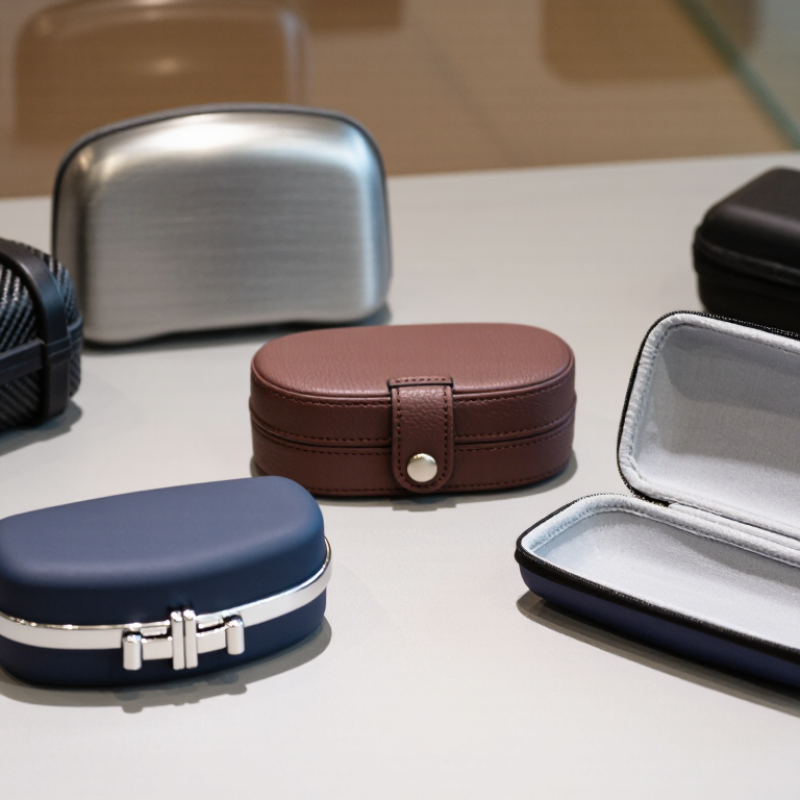
Choosing the right Optical Case can quietly influence product safety, customer satisfaction, and brand perception. A case is not merely packaging. It protects precision lenses, delicate hinges, and polished frames during storage, transport, and daily use. Robert Geller, a veteran optical case manufacturer, has emphasized, “A case must protect the product and represent the business.”
That principle gives buyers a practical starting point. Review the case’s interior lining, hinge strength, closure design, and resistance to crushing. Soft microfiber can help reduce surface marks, while firm molded shells offer stronger protection in busy retail environments. Size matters too. A frame should fit securely without pressure on the temples or bridge. Too much movement creates avoidable damage.
Think about real handling conditions. Will sales staff place cases in crowded drawers? Will customers carry them in handbags, backpacks, or vehicle compartments? A lightweight case may improve convenience, but excessive flexibility can reduce protection. A premium finish may support brand value, yet it can increase cost without improving durability.
No checklist is perfect. Business needs differ.
A reliable Optical Case should match the product, customer, and operating environment. Ask suppliers for material specifications, sample testing, and closure-cycle information. Inspect the case personally, not only through photographs. Small details often reveal manufacturing quality. A poorly aligned lid, loose seam, or strong chemical odor deserves attention.
The best choice balances protection, appearance, usability, and cost. It should also remain dependable after repeated opening, closing, and carrying. That balance is easy to describe, but harder to achieve. Careful comparison is necessary.
How to Choose the Best Optical Case for Your Business?
Define Business Needs with Frame Mix, SKU Count, and Annual Sales Data
The right optical case starts with your sales data, not its appearance. Review your frame mix by material, shape, size, and price range. Metal frames may need narrow slots, while thicker acetate frames require more depth. Count active SKUs, including slow-moving items. A store with 300 SKUs needs a different case from one carrying 1,500.
Annual sales reveal practical capacity needs. Compare monthly turnover with your current storage space. If a shop sells 100 frames monthly, holding every SKU on display may create crowded shelves. A case with adjustable dividers can support seasonal changes and reduce unnecessary replacements. However, sales records are sometimes incomplete. My own early estimates would have been too optimistic without checking damaged, returned, and discontinued frames.
Tips: Build a simple worksheet before ordering. Record frame dimensions, weekly movement, reorder frequency, and storage limits. Test several sample frames inside the case. Check whether hinges, lenses, and temples fit without pressure. Leave room for growth, but avoid paying for empty capacity. A 15 percent reserve is often more realistic than doubling storage. Small details matter. Inspect the case after repeated opening and cleaning. Practical testing may expose weaknesses that product images hide.
Choosing an optical case starts with the frame, not the outer shell. Measure the frame’s lens width, bridge width, temple length, and folded height. Add space for hinges, nose pads, and protective fabric. ISO 8624:2020 defines key spectacle-frame measurements, but it does not provide one universal case size. Your internal dimensions must therefore reflect the actual frame range you sell.
Measure at least 30 representative frames from your product mix. Include thick temples, oversized lenses, and flexible hinges. Record the largest folded length, width, and height. Then add closure tolerance. A practical starting point is 3–5 millimeters around the frame, depending on lining thickness and compression. The European Committee for Standardization’s EN 14889 guidance on spectacle cases highlights protection and usability, yet real-world fit still requires physical testing. Measurements alone can mislead.
Test the case after repeated opening and closing. Check whether the frame shifts, the hinge catches, or the lid presses against the lenses. WHO’s World Report on Vision estimates that at least 2.2 billion people have near or distance vision impairment, creating broad demand for eyewear protection. Still, one case cannot suit every frame. A 1-millimeter error may seem minor, but it can cause pressure marks, rattling, or poor closure. I would revise the tolerance after wear testing, not trust the first drawing.
A reliable optical case should protect both the frame and the lens during storage, transport, and daily handling. ISO 12870 tests frame durability through areas such as dimensional stability, resistance to deformation, and mechanical strength. It does not certify the case itself. Therefore, buyers should test the complete package, including hinges, padding, and internal pressure.
Lens safety needs separate attention. ISO 8980 covers ophthalmic lens performance, while ANSI Z87.1 addresses impact protection for applicable safety eyewear. A hard shell can reduce scratches and crushing, but poor internal fit may still damage coatings.
The World Health Organization reported that at least 2.2 billion people live with vision impairment. At least 1 billion cases could have been prevented or remain unaddressed. That scale makes dependable optical storage more than a packaging detail.
Tips:
Place a sample frame inside the case and apply repeated compression. Check whether the lens touches the lining. Inspect hinges after cleaning cycles. A useful field test is simple: shake, drop, and open the case repeatedly.
I have seen attractive cases fail because their foam shifts after weeks of use. That is an uncomfortable reminder. Appearance is not evidence.
Record test results, supplier specifications, and failure photos before choosing volume production.
Water resistance begins with measurable evidence, not showroom claims. ASTM D570-22 measures how much water a plastic absorbs after controlled immersion. Public engineering-material databases commonly report 24-hour absorption near 0.01–0.03% for polypropylene, 0.15–0.30% for polycarbonate, and 0.30–0.70% for ABS. These figures are typical ranges, not guarantees.
Polypropylene suits humid warehouses and repeated handling. It absorbs very little water, which helps limit swelling around hinges and molded closures.
Polycarbonate offers stronger impact performance, but its absorption is slightly higher.
ABS can provide a rigid, economical shell, although moisture may affect dimensional stability over time.
Small differences matter. A 0.5% change can become visible around a tight optical mount.
Test the finished case, not only the resin coupon. Seams, foam, fasteners, pigments, and recycled content can alter results. ASTM D570 also depends on specimen thickness, conditioning, temperature, and weighing accuracy.
I would request laboratory results showing the exact case material and test duration. Supplier data often looks cleaner than production reality. That is worth questioning.
A practical trial should include 24-hour immersion, drying, closure inspection, and optical alignment checks. Real shipment conditions may expose weaknesses that laboratory numbers miss.
How to Choose the Best Optical Case for Your Business?
Rank suppliers by MOQ, unit cost, defect rate, and recyclability metrics before approving any optical case order. MOQ affects cash flow, storage space, and product testing flexibility. A low unit price may hide expensive inventory. Cheap is not always cheap. Compare landed cost, including packaging, freight, inspection, and expected returns.
Defect rate needs a clear calculation. Request inspection records from at least three recent production batches. Check broken hinges, uneven stitching, weak magnets, surface scratches, and inaccurate dimensions. A supplier reporting 0.5% defects should explain the sample size and inspection method. My own early purchasing spreadsheet treated all defects equally, which was a mistake. A loose hinge can create more customer complaints than a minor color variation.
Recyclability requires evidence, not attractive claims. Ask for the case material, coating details, recycled content, and separation method for metal parts. A mixed-material case may be difficult to process, even when one component is recyclable. Review technical sheets and packaging specifications with your production or quality team. Then score each supplier using weighted criteria that match your business. For example, defect rate may matter more than MOQ for premium optical products. Test samples under daily handling conditions. Open and close the case repeatedly, place it in a crowded drawer, and inspect it after transport. Numbers need context. A supplier can rank well overall and still fail your practical test.
Supplier ranking based on MOQ, unit cost, defect rate, and recyclability. The composite score uses equal weighting; lower MOQ, cost, and defect rate receive higher scores, while higher recyclability receives a higher score.
Benchmark values are anonymized, representative optical-case sourcing figures. Confirm final terms through supplier quotations, samples, and quality audits.
| Supplier Profile | MOQ (units) | Unit Cost (USD) | Defect Rate | Recyclability |
|---|---|---|---|---|
| Profile A | 500 | $0.42 | 1.8% | 65% |
| Profile B | 1,000 | $0.35 | 2.4% | 80% |
| Profile C | 2,500 | $0.28 | 1.2% | 90% |
| Profile D | 5,000 | $0.23 | 0.9% | 95% |
| Profile E | 800 | $0.39 | 1.5% | 75% |
Review frame materials, shapes, sizes, prices, active SKUs, and annual sales. Include slow-moving frames. A store with 300 SKUs needs less capacity than one with 1,500. Compare monthly turnover with current storage space. Leave about 15 percent extra room, rather than doubling capacity.
Thin metal frames may fit narrow slots. Thick acetate frames need deeper compartments. Hinges, lenses, and temples should fit without pressure. Test real samples inside the case. Product photos are not enough.
Record frame dimensions, weekly movement, reorder frequency, and storage limits. Note damaged, returned, and discontinued frames. These details can change the estimate. My early estimates were too optimistic without them.
Place a sample frame inside the case. Check whether the lens touches the lining. Apply repeated compression and inspect the hinges. Shake, drop, and reopen the case several times. Small tests reveal hidden weaknesses.
Clean the case repeatedly and open it many times. Check shifting foam, loose hinges, weak magnets, scratches, and changing dimensions. A case may look attractive initially. That can be misleading.
Compare minimum order quantity, landed unit cost, defect rate, and recyclability. Include freight, inspection, packaging, and expected returns. Cheap is not always cheap. Use weighted scores matching business priorities.
Request inspection records from three recent production batches. Ask for the sample size and inspection method. Check broken hinges, uneven stitching, scratches, weak magnets, and inaccurate dimensions. A reported rate means little without context.
Request material details, coating information, recycled content, and metal-separation methods. Mixed materials may be difficult to process. Review technical sheets with the quality team. Claims alone are not evidence.
Choosing the best Optical Case for your business begins with a clear understanding of your product range and sales goals. Review your frame mix, total SKU count, and annual sales data to determine the right case styles, quantities, and inventory levels. Next, measure the frames carefully and use closure tolerance data to establish suitable internal dimensions. A well-fitted case should protect the frame without creating unnecessary pressure or movement during storage and transport.
Protection and material performance should also guide your decision. Evaluate cases against relevant frame-protection requirements, including ISO 12870 testing considerations and lens-safety needs. Compare materials using ASTM D570 water-absorption data to understand how they may perform in humid or wet conditions. Finally, assess suppliers by reviewing minimum order quantities, unit costs, defect rates, production consistency, and recyclability metrics. A structured comparison will help you select a durable, practical, and cost-effective Optical Case that supports both customer satisfaction and long-term business efficiency.
